



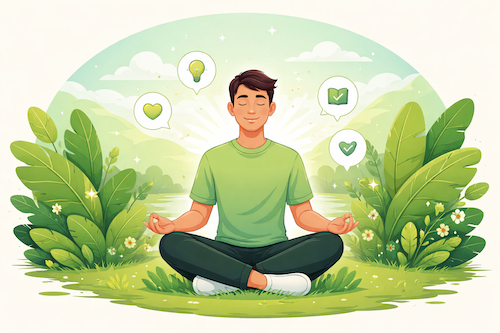
Here’s an important thought: The quality of your life isn’t determined by the things that happen to you—although they obviously have an impact—but by what you choose to focus on.
We don’t often think about it, but it becomes clear in times of crisis. Faced with a serious medical diagnosis, an accident, or a loss, many people suddenly discover a capacity for focus they didn’t know they had. The background noise fades away. What matters is laid bare. And yet, paradoxically, in the midst of objectively difficult circumstances, some people say they feel a strange sense of clarity, even a kind of fulfillment.
It’s not that odd. Neuroscience has been pointing out for decades that the mind constructs subjective experience based on what it focuses on, not on the facts themselves. What you choose to look at defines what you see. What you choose to pay attention to defines who you are.
Attention is an increasingly scarce resource
We live under the belief that if our lives improve (more money, a better job, more free time), we’ll feel better. But the link between our circumstances and our well-being is much weaker than we think.
What does have a strong correlation with life satisfaction is the mental state in which we spend most of our time. And that mental state depends, to a large extent, on where we focus our attention.
Psychologist Mihaly Csikszentmihalyi spent decades studying when people feel most alive and engaged in what they are doing. His conclusion was counterintuitive: it’s not during rest or passive leisure, but when we’re performing tasks that demand our full capacity. He called this flow state. It’s the state of the craftsman working metal with pinpoint precision, of the programmer solving a complex problem, of the writer finding just the right phrase. A state of complete absorption in which one loses track of time.
What makes that experience meaningful is not the final result, but the care and attention invested in the process. It’s not the finished piece that gives meaning to the blacksmith’s life; it’s the act of forging it with skill and care.
The problem of the knowledge worker
The connection between deep work and a good life is easy to see in craftsmanship, but it’s harder to see in knowledge work. Most of us don’t forge swords or carve wood. We manage projects, make decisions, write, analyze, and coordinate. And we do all of that in environments designed for constant interruption: notifications, meetings, messages, and emails that demand an immediate response.
The result is that we spend much of the day in a state of fragmented attention. Never fully present in any task, never completely absent. Always available, always partially engaged. And that state, which may seem productive because it generates constant activity, is the exact opposite of the flow state. It’s the state in which we work the hardest and achieve the least. And it’s also the state in which we feel the least.
Scattering isn’t just a performance issue. It’s a matter of quality of life.
GTD as infrastructure for attention
This is where personal productivity comes into play. And more specifically, what a methodology like GTD can offer, which is something that to-do apps or time-management tricks simply can’t.
Getting Things Done is based on a premise that aligns directly with all of the above: the human mind is designed to generate ideas, not to store them. When we try to remember everything we have pending (commitments we’ve made, ongoing projects, things we don’t want to forget) we use up a significant portion of our cognitive capacity on a task for which we aren’t well equipped. The result is a constant sense of mental background noise that makes deep concentration nearly impossible.
The practice of capturing everything in a trusted external system (one that you check regularly and truly trust) isn’t just an organization trick. It’s the act of freeing your mind so it can do what it does best: think, connect, create, and solve problems. It’s about creating the conditions for your attention to be directed intentionally, rather than scattered by inertia.
The process of clarifying every item you capture (deciding what it is, what it means to you, and what specific action it requires) forces you to reach a level of understanding about your commitments that very few people have. And that clarity is what allows you, when the time comes to work, to really get to work , without that layer of ambiguity that causes your brain to keep circling back to the same thing because it doesn’t know exactly what to do with it.
When it’s time to work, the system encourages you to focus exclusively on what you can do within your current context: with the tools at your disposal, the time you have, and the energy you have. What doesn’t fit into that context simply doesn’t exist for now. This isn’t just a decision about efficiency. It’s a design choice aimed at protecting your attention. GTD doesn’t tell you to “work faster.” It tells you to “work here, on this, now.” And in an environment that’s constantly competing for your attention, that’s a form of resistance.
The weekly review, that moment of reflection that GTD recommends as a regular practice, closes the cycle. It lets you know, with reasonable confidence, that nothing important will fall through the cracks. And that confidence, along with the sense of being in control, is exactly what you need to immerse yourself in work that demands your full attention.
Choosing what to focus on
In the end, a productive life in the fullest sense isn’t just a life in which you do a lot of things. It’s a life in which you do the right things the right way, with a genuine presence in what you’re doing. A life in which you decide what to focus on, rather than letting the demands of your surroundings make that decision for you.
I agree that this is easier said than done. Distraction is the default state in the modern world. Sustained attention must be built, protected, and fostered with an infrastructure that makes it possible. GTD isn’t the only way to do this; however, it’s one of the most comprehensive approaches, because it doesn’t just manage tasks. It offers a way to engage with your commitments that gives you back the control over your own attention.
And gaining back the control over your attention is, in many ways, gaining back the control over your life.

2 comments
A great article and reminder that GTD is not some fad or pseudo-science. It is based on years and years of observation, refinement, testing, and education. GTD has helped me work through the noise of life during my most brutal of times, from divorce and death to marriage and new careers. It works and works well, but only if you are an active participant in your own life. GTD won't do the thinking or the doing for you. It does, however, make all of that much easier. And dare I say it, exceedingly fun and fulfilling.
A great article and reminder that GTD is not some fad or pseudo-science. It is based on years and years of observation, refinement, testing, and education. GTD has helped me work through the noise of life during my most brutal of times, from divorce and death to marriage and new careers. It works and works well, but only if you are an active participant in your own life. GTD won't do the thinking or the doing for you. It does, however, make all of that much easier. And dare I say it, exceedingly fun and fulfilling.
Hi, Cyrus!
You’re absolutely right: GTD is a great help in dealing with life in general, through both its ups and downs. That’s what any truly comprehensive and holistic system should offer its users. I’m glad you can celebrate GTD with us and benefit from it in so many ways. You’re also right to emphasize its positive side—it’s not just about the problems it helps mitigate, but also the good it actively creates. Truly powerful things are like that: not merely reactive, but proactive.
Best regards,
María
Hi, Cyrus!
You’re absolutely right: GTD is a great help in dealing with life in general, through both its ups and downs. That’s what any truly comprehensive and holistic system should offer its users. I’m glad you can celebrate GTD with us and benefit from it in so many ways. You’re also right to emphasize its positive side—it’s not just about the problems it helps mitigate, but also the good it actively creates. Truly powerful things are like that: not merely reactive, but proactive.
Best regards,
María