


Personal Productivity
Decision Fatigue: Why You Feel Exhausted Without Having “Done” Anything Physically
AUTHOR: María Sáez
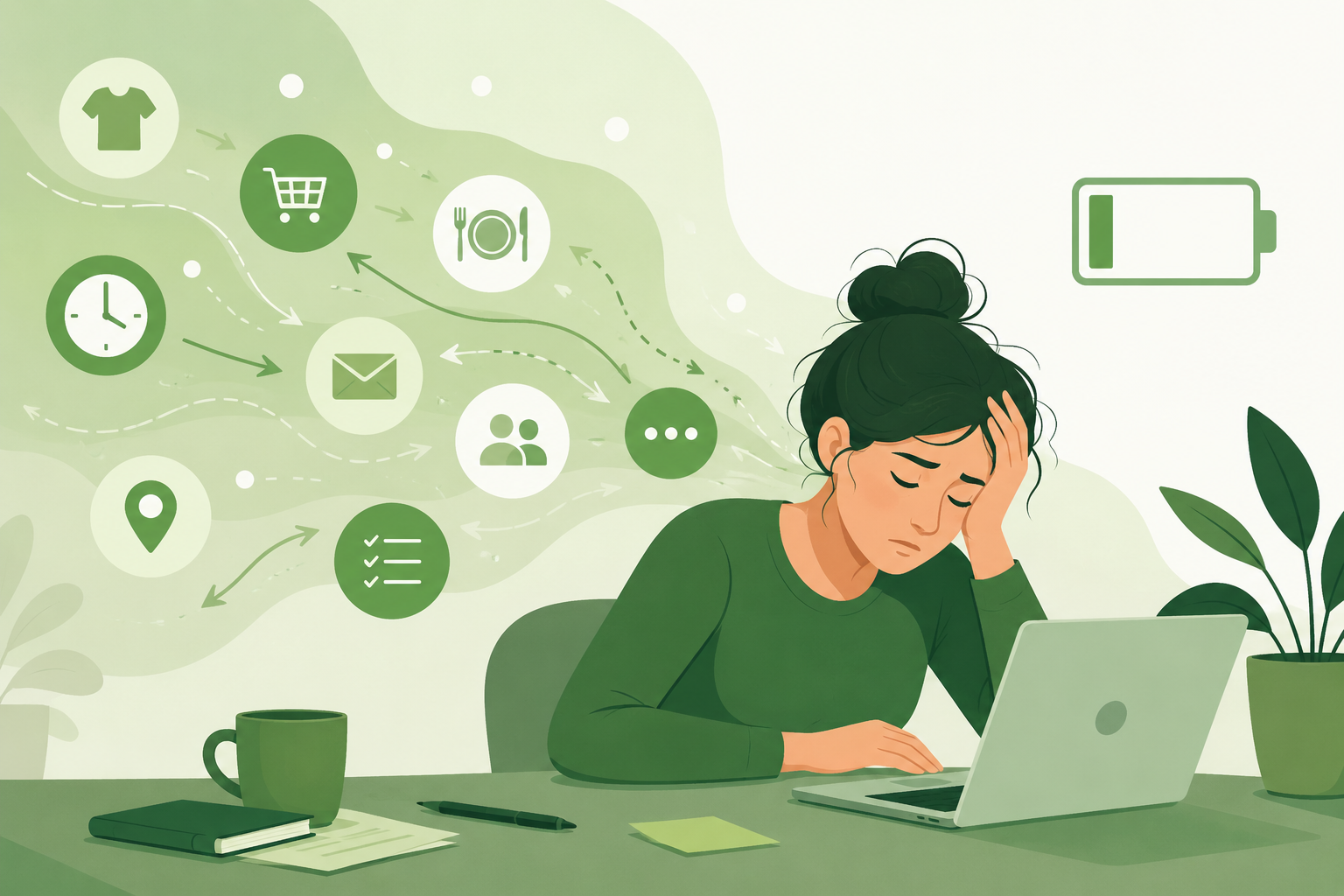
It’s seven o’clock in the evening. You haven’t moved a single box, you haven’t run, and you haven’t carried anything heavier than a cell phone. And yet, you feel that heavy, almost physical exhaustion that you normally associate with a day of house moving or a long workout. You sit down on the couch and don’t even have the energy to decide what to have for dinner. Why are you so tired?
The answer has to do with how many times you’ve had to make a decision throughout the day.
The brain is just like any other muscle. It gets tired
In the late 1990s, social psychologist Roy Baumeister proposed an idea that changed much of the subsequent research on self-control: that willpower works like a muscle 1. It can be trained, but it also becomes fatigued with use. In one of his most frequently cited experiments, he asked a group of hungry participants to resist the temptation to eat freshly baked chocolate chip cookies, while another group was allowed to eat them. Afterward, everyone was given an impossible puzzle to solve. Those who had had to resist the cookies gave up much sooner than those who hadn’t had to exercise any self-control beforehand. He dubbed the phenomenon ego depletion: the idea that resisting an impulse, making a difficult decision, or maintaining concentration all draw on the same limited mental resource, and that once that resource is depleted, less of it is available for the next task.
It’s important to note that this theory, despite its enormous influence, isn’t a settled matter. A large-scale replication study published in 2016, involving more than two thousand participants across various laboratories, failed to reproduce Baumeister’s original results, and since then, the academic debate over whether ego depletion exists as initially described has remained open 2. What does seem to hold true, even among the harshest critics of the original model, is the phenomenon itself: that the quality of our decisions deteriorates as we accumulate previous decisions, regardless of the exact mechanism that explains it.
Judges who made decisions based on the time of day
One of the most frequently cited examples of this decline comes from a study published in 2011 in the journal PNAS 3, which analyzed more than 1,000 parole decisions made by Israeli judges over the course of several months. The researchers found a striking pattern: the probability that a judge would grant parole dropped progressively throughout each work session, falling from about 65% at the start to nearly 0% at the end, only to rise sharply back to 65% immediately after each lunch break. It wasn’t the case, the prisoner’s record, or any legal factor that best predicted the decision: it was, quite simply, how many decisions the judge had made since their last break.
The study wasn’t free from criticism. Other researchers pointed out that part of the effect could be explained by a statistical bias related to the order in which the cases were presented, rather than by actual mental fatigue. But regardless of the exact explanation, the general pattern—that the quality of our decisions deteriorates the more we make—has been observed in very different contexts, from medical committees to shopping environments. And it ties in with something that anyone who spends their days making decisions recognizes immediately: deciding something at 9 a.m. is not the same as deciding it at 6 p.m.
Every decision counts, not just the important ones
The brain doesn’t seem to distinguish very well between the magnitude of a decision: deciding whether a task is a priority, whether to reply to that email now or leave it for later, in what order to do the three things you have pending, or whether that meeting could have been handled with a message. None of these decisions is dramatic on its own. But they pile up, one after another, for hours, and each one consumes a small portion of the same limited resource.
There’s a common belief that we make about 35,000 decisions a day. It’s a statistic that sounds compelling, but when you trace its origin, it falls apart amid loose estimates, misattributed quotes, and, in some cases, research that was later retracted. But we don’t need an exact (and likely made-up) figure to support the central idea: in a modern knowledge work, the number of microdecisions we make every day is high, constant, and almost always invisible to us.
The Real Cost: Cognitive Load
This brings us back to the original question. If no one would say that deciding what to write in an email is exhausting, why is the accumulation of hundreds of microdecisions so exhausting?
The answer lies in how working memory functions—that mental space where we keep information active while we process it. Psychologist John Sweller, who developed what is now known as cognitive load theory in the 1980s, demonstrated that working memory has a very limited capacity: it can hold only a few items at a time before becoming overloaded 4. Every pending decision, every unresolved task, every “I’ll decide this later” occupies a small portion of that limited space, even when we aren’t actively thinking about it. The system doesn’t completely let go: it continues to process in the background, keeping that information “open” in case it’s needed.
That “background processing” has a name and nearly a century of research behind it. In 1927, psychologist Bluma Zeigarnik observed that waiters accurately remembered the orders for tables that had not yet been paid for, but forgot those same details as soon as the bill was settled. In the lab, she confirmed that interrupted tasks are remembered better than completed ones: something in the mind keeps the unfinished “open” 5. Decades later, psychologists E. J. Masicampo and Roy Baumeister took this idea to a more practical level 6. In a series of experiments published in 2011, they found that having an uncompleted goal generated intrusive thoughts during completely different tasks and impaired performance on problem-solving exercises. The simple fact of having something pending (unresolved, undecided, or not written down anywhere reliable) consumed mental resources that should have been available for something else.
Here is, perhaps, the most useful finding in this entire area of research: in those same experiments, all the participants had to do was formulate a concrete, specific plan for tackling the pending task (not to complete it, but simply to decide when and how they would do it) for the intrusive thoughts to disappear and their performance to return to normal. The mind did not need the task to be completed. It needed it to be decided.
Recognize the signs
Decision fatigue rarely presents itself as such. It manifests as the feeling of being unable to choose what to eat after a day’s work, even though you’re hungry. Like the irritability that appears out of nowhere at six in the evening for no clear reason. Like systematically choosing the easiest option, or the one you’re already familiar with, over the one that would probably be better, simply because evaluating alternatives requires an effort you no longer have. Like that small, almost trivial task you’ve been putting off all day, not because it’s difficult but because deciding how to tackle it is, in itself, yet another decision your brain would rather postpone.
Recognizing these signs is a valuable exercise in self-awareness. It’s the first step toward understanding that the exhaustion you feel at the end of the day, that “I can’t take it anymore” feeling with no obvious physical cause, has a fairly specific explanation and, above all, is quite manageable.
What the research suggests
None of these studies points to a magic solution, but they do, quite consistently, point in the same direction.
- The first is to reduce the number of trivial decisions we make without realizing it: the more routines and default settings we have for repetitive tasks, the fewer resources we spend on decisions that add no value simply because they are deliberate.
- The second is to get pending decisions out of our heads and put them somewhere external and reliable: not because writing something down solves the problem, but because, as Masicampo and Baumeister demonstrated, the mind stops actively monitoring what has been captured and decided elsewhere.
- And the third, perhaps the easiest to overlook, is to avoid making the same decision over and over again: every time we revisit a decision we’ve already made, we pay the full cognitive cost all over again, as if we’d never resolved it in the first place.
None of these three principles requires a complex methodology or a specific tool. It simply requires understanding that the mind is not designed to juggle hundreds of open decisions at once, and that much of the exhaustion we feel at the end of the day doesn’t come from what we did, but from everything we had to decide at some point.
1 Baumeister, R. F., Bratslavsky, E., Muraven, M., & Tice, D. M. (1998). Ego depletion: Is the active self a limited resource?
2 Hagger, M. S. et al. (2016). A multilab preregistered replication of the ego-depletion effect. Perspectives on Psychological Science.
3 Danziger, S., Levav, J., & Avnaim-Pesso, L. (2011). Extraneous factors in judicial decisions PNAS.
4 Sweller, J. (1988). Cognitive load during problem solving. Cognitive Science.
5 Zeigarnik, B. (1927). Über das Behalten von erledigten und unerledigten Handlungen.
6 Masicampo, E. J., & Baumeister, R. F. (2011). Consider it done! Plan making can eliminate the cognitive effects of unfulfilled goals Journal of Personality and Social Psychology.

4 comments
These amazing articles help and inspire me and I often share them with family and friends. Special thanks to Maria!
These amazing articles help and inspire me and I often share them with family and friends. Special thanks to Maria!
Hello, Michael,
Thank you for your kind words and your wonderful support. I'm glad you find my articles valuable enough to share them with your loved ones.
Best regards,
María
Hello, Michael,
Thank you for your kind words and your wonderful support. I'm glad you find my articles valuable enough to share them with your loved ones.
Best regards,
María
Fascinating article. I do find myself writing a list of things to do and now I can see why that helps me to feel better. I will definitely be sharing with family!! Warmly appreciated!!
Fascinating article. I do find myself writing a list of things to do and now I can see why that helps me to feel better. I will definitely be sharing with family!! Warmly appreciated!!
Hello, Jane!
Thank you for your kind words. I'm glad the article explains, confirms, and reinforces something you've already been doing intuitively.
Thank you as well for sharing it. That kind of support means a lot to us, and it says a great deal about the value you've found in our work.
Best regards,
Maria
Hello, Jane!
Thank you for your kind words. I'm glad the article explains, confirms, and reinforces something you've already been doing intuitively.
Thank you as well for sharing it. That kind of support means a lot to us, and it says a great deal about the value you've found in our work.
Best regards,
Maria