


Getting Things Done - GTD
The Someday/Maybe List: How to Keep It from Becoming a Black Hole
AUTHOR: María Sáez
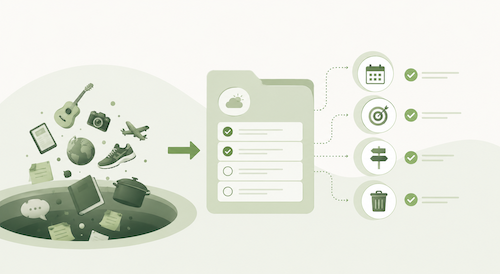
Within the Getting Things Done workflow, the Someday/Maybe list occupies a unique place. It’s not an action list, even though it includes “potential” actions. It’s something similar to what would be called a reserve warehouse in logistics: a space where you store things that have potential future value, but which, for the time being, don’t require any commitment on your part. In some places, it’s called the incubator.
David Allen conceived of this list as a powerful creative tool, capable of bringing great adventures into your life and work. It gives you permission to write down anything that comes to mind, without any restrictions whatsoever. There will be time later to figure out whether it makes sense or not. In short, it’s a way to procrastinate effectively: you postpone the decision until a more appropriate time, but you don’t lose track of it.
There are no “bad” ideas, only ideas that are ahead of their time. That philosophy is what gives meaning to this list. Anything you can’t or don’t want to commit to right now, but don’t want to dismiss, has a place here: personal and professional projects, trips you’d like to take, books you want to read, courses that interest you, business ideas in their infancy, or skills you’d like to develop someday.
When the creative warehouse of your GTD system turns into a monster
The problem with the Someday/Maybe list is well known to any GTD practitioner with some experience: the list tends to grow and grow without end, to the point where it becomes very difficult to manage and loses much of its usefulness.
When you come across 865 items to go through in your weekly review, you just skip that step altogether. And that’s exactly the problem: you accumulate potentially interesting things, but since you never review them, they’ll never have a chance to leave the backlog and come into play; or to disappear, if they’ve stopped being interesting.
The aversion that a list like this provokes is not irrational. It’s a logical response to a system that has ceased to inspire confidence. A “Someday/Maybe” list that’s scary to open has stopped doing its job. Getting it back on track requires some work and, above all, a shift in how we manage it.
How to organize the list so it remains useful
Capture correctly from the beginning
The first mistake that causes your list to blow up is adding items without clarifying them. The “Someday/Maybe” list isn’t a dumping ground for unprocessed items. If you start adding items directly from your inbox without clarifying the desired outcome, you’ll quickly grow to hate that list, stop checking it, and the domino effect that ends your GTD system will have begun.
Every item added to the list must first have gone through the Clarify step. This means you know exactly what it represents and have enough context to recognize and evaluate it when you see it in a future review.
Write entries that can be found
The wording of each entry is more important than it seems. An entry like “Italy” or “learn some music” won’t tell you anything useful three months later. An entry like “A week-long trip through Tuscany with my partner, in the fall” or “Learn the basics of music theory to better understand the jazz I listen to” provides enough context to spark your interest and help you decide whether the time is right or not.
Use result verbs whenever possible. Don’t say “take photos,” but rather “Take a street photography course and go out to practice regularly.” The phrase should evoke something specific, not just a vague idea.
Organize by topic using tags
One of the most effective ways to manage a long list is to organize it using topic-based labels. This doesn’t mean creating rigid subfolders, but rather assigning a label based on a specific area of life or work to each item: travel, education, home, health, reading, personal-projects, work, technology, etc.
This allows you to filter the list at any time and view only the items in a specific category. When you’re thinking about what to do on your next vacation, you can view only your travel items. When you feel like starting something new at work, you can view only work projects. The list stops being a jumble of items and becomes a navigable catalog.
You can keep a single “Someday/Maybe” master list or break it down into subcategories, which can help you distinguish between things you want to do as soon as you have the time and money, such as home renovations, and “life wish list” items, such as learning French. Both types have their place, but mixing them without distinguishing between them creates that sense of chaos that makes reviewing the list so unpleasant.
Sort by ways of management as well
In addition to topic labels, it’s a good idea to add a second dimension: how and when each item should be reviewed. This brings us to a fundamental distinction that many GTD practitioners discover over time.
Not all items on the “Someday/Maybe” list have the same timeframe or the same level of uncertainty. Some are long-term ideas, dreams, or aspirations that don’t depend on specific external circumstances: “Learn to play the piano,” “Write a book about my entrepreneurial experience.” These can lie dormant for months or years without causing any problems.
On the other hand, some actions aren’t really set and could change from one week to the next: an opportunity you’re considering, a project you might launch if resources become available, or an idea that may have already been developed. These do require a weekly review so you don’t lose track of them.
José Miguel Bolívar’s “Not This Week” Trick
It’s precisely this distinction between items that require weekly review and those that don’t that José Miguel Bolívar, a GTD expert and author of Personal Productivity: Learn to Free Yourself from Stress with GTD, formalized with his “Not This Week” list.
The idea is basically to split the “Someday/Maybe” list into two parts: one that includes items you need to review every week, and another that includes items you only need to review under certain circumstances.
The first one continues to serve as a repository for ideas and goals that may be achieved in the long term. The second one (“Not this week”) is for all those tasks you’ve already identified that you won’t be doing next week but that could be completed in the short term. The goal is to avoid having to go through the entire list during every weekly review.
The key difference is that the “Not This Week” list is influenced by external circumstances, while the “Someday/Maybe” list depends entirely on your own will. The first can change from week to week; the second, can’t.
You only review your long-term dream list when you have the time, energy, or desire to explore more distant horizons, or simply when the right circumstances arise.
Diogenes Syndrome on the “Someday/Maybe” List
There’s a silent habit that contributes just as much to the list’s uncontrolled growth as a lack of organization: the inability to delete items. Many GTD practitioners accumulate items for years without deleting practically anything, as if getting rid of an item meant giving up a part of themselves.
It’s understandable. The “Someday/Maybe” list is full of aspirations, dreams, and future versions of ourselves. Crossing off “Learn to sail” or “Start a business in Portugal” can feel like closing a door, admitting that something that once excited us is no longer going to happen. But that resistance comes at a real cost: a list full of items that no longer represent you is a list you no longer trust, and one you stop looking to for inspiration.
Life changes. Priorities change. What excited you three years ago may have lost all its appeal, or may have become completely unachievable given your current circumstances. An item that’s been on your list for two years without you feeling any urge to act on it probably no longer deserves a spot there. Not deleting it doesn’t keep it alive, it just clutters up the system.
Clearing out the “Someday/Maybe” list during your weekly review, or at least on a regular basis, isn’t an act of giving up. It’s an act of honesty with yourself and respect for your own system. A shorter, more up-to-date list that’s better aligned with who you are today is infinitely more useful than an exhaustive list of who you thought you’d be a decade ago. What’s more, it builds something that, in GTD, is worth more than any technical feature: confidence. The confidence that comes from knowing that what you see on that list still matters.
FacileThings and the smart Weekly Review
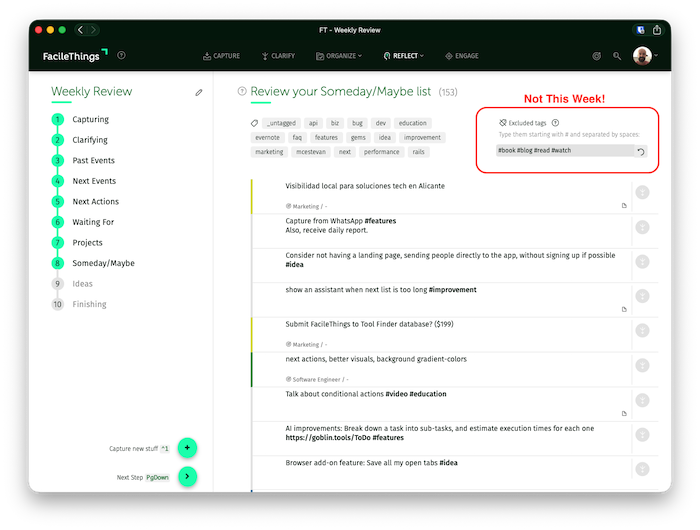
FacileThings allows you to classify your Someday/Maybe list items with as many tags as you need, and natively incorporates the concept of “not this week” list.
You can define a set of tags that are excluded from the weekly review, so only the items that do not have those tags and that should be reviewed this week appear on the screen.
The result is immediate: instead of being faced with hundreds of items, your weekly review of your Someday/Maybe list is reduced to a manageable set of items that are relevant to the present moment. The rest remains organized and accessible when you need it, but without getting in the way of your regular review.
This combination of well-chosen tags, well-written posts, and a clear distinction between what gets reviewed weekly and what doesn’t, is what transforms the “Someday/Maybe” list from a black hole into what it was always meant to be: a fertile reservoir of possibilities that inspires rather than overwhelms.
A list that deserves careful attention
The “Someday/Maybe” list isn’t a junk pile where you dump everything you don’t know where to put. When managed well, it’s one of the most valuable assets in your GTD system. It contains what you could become, what you’d like to explore, and what matters to you beyond what’s urgent.
Like any asset, it requires maintenance. Capturing information effectively, writing with sufficient context, categorizing thoughtfully, and reviewing intelligently (only what’s needed, when it’s needed) are the habits that keep it useful.

No comments