

Getting Things Done - GTD
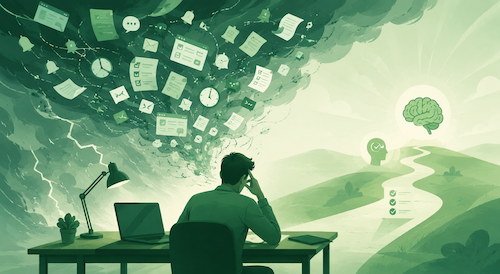
The Perfect Storm: Why Modern Work Overwhelms and How to Deal with It
AUTHOR: María Sáez
Brief introduction to the GTD methodology:
1. The Perfect Storm: Why Modern Work Overwhelms and How to Deal with It
2. Capture and Clarify: The First Two Steps of the GTD Workflow
3. Organize, Reflect, and Engage: The Three Steps That Complete the GTD Workflow
4. How to Get Started with GTD: Set up a System That Works and Make It a Habit
It’s Monday morning. You open your laptop and already feel the weight of it before you even read the first email. The feeling that there’s too much to do, that no matter how much you get done today, you’ll still have a lot left to do tomorrow. You’re hard-working and disciplined, so something must be slipping through the cracks.
That’s right. What’s happening is the natural result of two forces that have collided predictably: the nature of work has changed radically, and our brains continue to function according to the same design as always.
Work isn’t what it used to be
Throughout most of human history, work meant producing something tangible with one’s hands. It was obvious, predictable, and its output was proportional to the time invested. Economist Peter Drucker was the first to point out, in the late 1950s, that this was changing. A new class of worker, the knowledge worker, was beginning to dominate the economy. Unlike the manual laborer, who performs tasks already defined by someone else, the knowledge worker must define his or her own work before being able to do it.
That detail shifts the paradigm of work. It’s no longer enough just to “do”; you have to decide what to do, in what order, and what to leave undone, because there’s never enough time for everything. Knowledge work is unpredictable by nature, and there’s always something left undone at the end of the day. Performance no longer depends solely on execution, but on the quality of thinking and the decisions that are made. Drucker called it the greatest management challenge of the 21st century, and rarely has a prediction aged so well.
A brain that wasn’t designed for this
We’re the result of millions of years of evolution, and our brains operate using two very distinct thinking systems. Daniel Kahneman, a Nobel laureate in Economics for his work on the psychology of decision-making and behavioral economics, popularized them as System 1 and System 2. System 1 is automatic, fast, emotional, and impulsive; it operates in parallel with everything else and cannot be turned off. System 2 is manual (it must be consciously activated), single-tasking, rational, and energy-intensive. According to Kahneman’s own estimates, the vast majority of our mental activity takes place in System 1: System 2 comes into play only a small fraction of the time, and it does so reluctantly, because it takes effort.
Over time, some processes migrate from System 2 to System 1. What initially requires total concentration—driving, typing, applying a new methodology—eventually becomes automatic. This is great news, because it means the initial effort isn’t permanent. But while that process is underway, we rely on System 2, and System 2 has very real limitations: limited mental energy and decision-making capacity, and a memory that becomes overloaded much sooner than we’d like to admit.
Let’s add one more ingredient: our brain developed, purely for survival, an “alert mode” that treats the unknown as a potential threat. That mechanism made sense when the unknown was a predator lurking in the bushes. Today, that same alert mode is triggered by an unprocessed inbox, by a half-formed idea swirling around in your head, by a commitment that exists nowhere but in your memory. The result is stress, even when there’s no real danger, just unresolved information.
The perfect storm and its consequences
When these two forces combine —work that constantly demands thinking and decision-making, and a brain with limited resources that interprets pending tasks as a threat— the result is what David Allen, who had spent decades closely observing how top-performing professionals work, named the perfect storm, and its consequences are all easy to see in today’s society.
We procrastinate because putting things off is the brain’s natural response to uncertainty. We choose instead of deciding because, when everything is competing for the same limited attention, we tend to do what’s easiest to check off the list, not what’s most important. We rely on our memory more than we should, and that unfounded reliance creates underlying stress that we often don’t even recognize as such. When under pressure, System 1 takes over and System 2 shuts down: stress makes us less competent just when we need to be at our best. We overplan in response to the need for control, achieving a false sense of mastery over something we don’t actually control; and we constantly interrupt ourselves, jumping from one thing to another, because the mental noise of pending tasks pushes us to check, review, and start over.
To a greater or lesser extent, this happens to all of us. It’s the logical response of a brain that was designed for a different kind of world and is now faced with a reality for which it hasn’t yet evolved.
Effectiveness: The Missing Skill
If the problem is structural, the solution must be as well. It’s not about “trying harder” or finding more discipline; both of these rely on System 2, precisely the one that runs out of steam first. It’s about developing a new skill: effectiveness, understood as the combination of efficacy and efficiency. This isn’t just an aspirational idea; it’s backed by evidence and works for anyone who applies it consistently. It rests on three pillars: proactively managing interruptions rather than suffering through them; adaptive planning that assumes the plan will change (“we’ll see how it goes”) rather than forcing a rigid script; and what is often called the extended mind—that means letting go of the expectation that memory can handle a task it isn’t designed for.
This last idea is simpler than it looks. Instead of relying on your memory, you place a visible external reminder where it makes the most sense. It’s exactly the same idea as leaving something by the front door so you don’t forget it when you leave. Externalizing is a way to relieve your brain of a task it’s not very good at, freeing it up for what it does well: thinking, deciding, and creating.
When this is applied systematically, what we might call the productive experience emerges: you feel in control, stress-free, focused, and fully present in what you’re doing. It’s a state we’ve all experienced at some point, almost always by accident. Our challenge is to get there most of the time, rather than having it happen only occasionally and by chance.
Five steps towards getting back in control
David Allen developed the Getting Things Done methodology precisely to address this perfect storm. Essentially, it’s a five-step process that, once internalized as a habit, allows you to take control of your own workload. Capture everything that demands your attention, without leaving anything solely in your memory. Clarify what each item really means and what specific action it requires. Organize the result into a system you can rely on. Reflect regularly, reviewing the big picture so you don’t lose perspective. And take action, choosing what to do at every moment with the confidence that it’s the right choice, because everything else has already been captured, clarified, and organized elsewhere.
A study by Productivity Scan, conducted in collaboration with the David Allen Company, documented a minimum 20% improvement in personal productivity in low-performance settings following the implementation of GTD. But perhaps the most significant finding isn’t the percentage itself, but rather the mechanism: it’s not about working faster, but about stopping wasting mental energy on managing what an external system can manage for you.
There are no shortcuts, but you don’t have to wait years either
There’s one thing you should know: making these five steps second nature doesn’t happen overnight. Research on habit formation (the benchmark study is by psychologist Phillippa Lally of UCL) shows that it takes an average of 66 days for a new behavior to become automatic, although the actual range varies between 18 and 254 days depending on the person and the habit. It’s not two years, but it’s not three weeks either. It’s a real process, with its own pace, and it’s best not to get discouraged if it requires conscious effort at first.
The good news is that the benefits don’t wait until the habit is firmly established. From the very first day that something leaves your head and enters a system you trust, that “alert mode” which used to perceive pending tasks as threats, eases up a bit. You don’t need to master the methodology to start noticing a difference, you just need to start.
The perfect storm isn’t going away. Knowledge work will remain unpredictable, and our brains will continue to have the same limitations they’ve always had. But that doesn’t mean we have to navigate it without tools. The question isn’t how to avoid the storm, but what system we build to weather it with a clear head.

No comments